
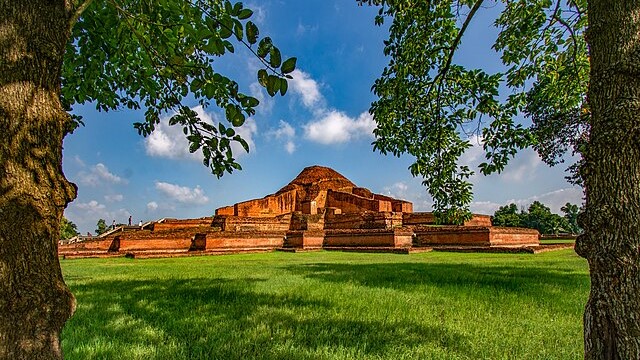
Most visitors come to Paharpur to see Somapura Mahavihara, the monumental 8th-9th century Buddhist monastery that anchors the site and gave the area worldwide recognition.
Somapura Mahavihara was constructed under the Pala dynasty, with patronage often attributed to King Dharmapala and his successors. The complex originally served as a major center for Buddhist learning and monastic life, hosting scholars, pilgrims, and artisans who shaped religious and architectural traditions across South and Southeast Asia.
The architectural plan centers on a large square monastery surrounding a cruciform central shrine that rises above the platform. Brickwork, terracotta panels, and finely carved motifs decorate the remains, with scenes from Jataka tales, celestial figures, and geometric patterns providing insight into contemporary religious art and iconography.
Archaeological excavations have revealed hundreds of monk cells arranged around cloistered courtyards, ceremonial stairways, and ancillary structures that speak to the site’s institutional scale. Scholarly attention has highlighted Somapura’s influence on later temple designs in regions as far afield as Myanmar and Indonesia, where variations of the central-shrine concept reappear in later Buddhist architecture.
UNESCO inscribed Somapura Mahavihara as a World Heritage Site in 1985, citing its historical importance and architectural innovation. Conservation efforts continue to address weathering, brick decay, and the challenges of preserving fragile terracotta reliefs, while local and national agencies manage visitor access and onsite interpretation.
Paharpur is located in Naogaon District in northern Bangladesh and is accessible by road from major cities such as Rajshahi and Dhaka. Travelers can reach the site by bus, private car, or organized tour; local guesthouses and hotels are available in nearby towns for overnight stays. Onsite facilities are modest, so carrying water, sun protection, and small change for entrance or guide fees is advisable.
Guided tours provide valuable context about the complex’s layout, symbolism, and excavation history, and a small museum near the ruins displays artifacts recovered from the site. Respectful clothing is recommended because of the site’s religious and historical character, and visitors should avoid climbing on fragile structures or touching exposed carvings.
Best visiting conditions occur during the dry season when pathways are easier to traverse and outdoor viewing is more comfortable. Quiet observation of the ruins allows appreciation of the scale and craftsmanship that made Paharpur a major center of Buddhist learning and a lasting testament to the artistic achievements of the Pala period.