
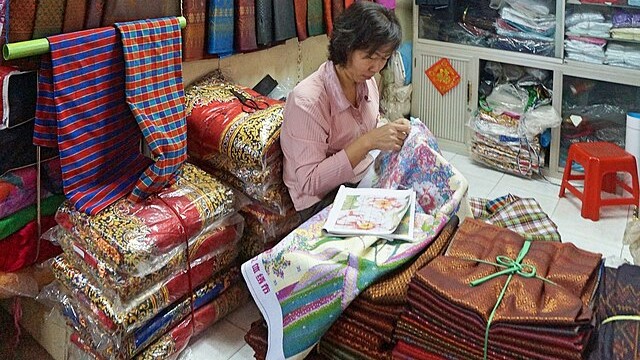
Cambodia sustains rich handicraft traditions-silk weaving, silverwork, woodcarving-and bustling markets like Siem Reap Night Market, showcasing artisan skills and Khmer cultural identity.
Masterpieces of Cambodian Craftsmanship
Artisans in provincial workshops preserve time-honored techniques that produce Cambodia’s most revered works, from woven brocades and delicate silver boxes to monumental stone reliefs that anchor cultural memory.
Silk Weaving and the Golden Thread Tradition
Silk weaving remains a living art in villages where ikat patterns and supplementary gold thread create ceremonial textiles worn at weddings and festivals.
Stone Carving: Legacy of the Khmer Empire
Stone carving preserves motifs seen on Angkor temples, with artisans chiseling sandstone into apsaras, lintels, and narrative panels for temples and private commissions.
Carvers follow apprenticeship lines, use traditional mallets and chisels, and apply precise relief depth to convey movement and epigraphy while efforts continue to restore and replicate damaged Angkorian works.
Silverware and Betel Nut Containers
Silversmiths craft ornate betel nut containers and jewelry using chasing, filigree, and repoussé, serving both ceremonial and decorative roles in Khmer households.
Crafting these pieces involves hammering thin sheets, soldering fine wires for filigree, and inlaying motifs inspired by nature and mythology, with some workshops preserving colonial-era silver styles.
Lacquerware and Decorative Arts
Lacquerware combines sap, clay, and pigments to produce glossy bowls, boxes, and panels, often embellished with gold leaf and narrative painting for homes and temples.
Techniques include multiple layers of sap and drying cycles, fine sanding, and hand-applied pigments that yield deep color and resilience, while motifs range from lotus and naga to scenes from the Reamker.
Cultural Significance and Historical Roots
Symbolism in Traditional Khmer Motifs
Ornamentation in Khmer motifs-naga serpents, apsara dancers, lotus blooms and garuda-encodes cosmology, protection and social rank; repeated patterns signal lineage, regional identity and ritual purpose, linking everyday objects to mythic narratives shaped by Angkorian art and Buddhist iconography.
The Role of Handicrafts in Spiritual Life
Communities use hand-woven textiles, carved altarpieces and silver ritual items in offerings, ordinations and merit-making, where artisans supply sacred objects that mediate between devotees and deities, reinforcing both communal devotion and continuity of liturgical forms.
Artisans often inherit techniques through family lineages and maintain strict workshop protocols for consecrated pieces. Temple carpentry and bronze casting require ritual purity and specific motifs tied to Buddhist cosmology, while weavers create textiles used as monk robes and ceremonial banners that mark life-cycle events.
Preserving Heritage in the Post-Conflict Era
Revival of traditional crafts after conflict has combined government programs, NGOs and market demand to restore lost skills, revive artisan communities and reestablish craft markets as sources of income and cultural pride.
Programs by ministries, UNESCO and local cooperatives have established apprenticeships, technical training and heritage documentation to rebuild supply chains and preserve technique. Private enterprises and ethical tourism create steady demand, yet artisans face generational shifts, material shortages and pressures to simplify designs for mass markets, prompting targeted conservation, quality standards and community-led museums.
Vibrant Markets and Artisan Hubs
Phnom’s markets and provincial artisan districts reveal textures and living techniques that sustain craft traditions while linking makers to local and international buyers.
Central Market and Russian Market in Phnom Penh
Central Market and Russian Market offer rows of silver, silk, rattan and lacquerware, mixing ready-made souvenirs with bespoke workshop pieces and wholesale materials for designers.
Artisan D’Angkor and the Siem Reap Craft Scene
Artisan D’Angkor anchors Siem Reap’s craft network, displaying restored Khmer carving, traditional silk weaving, and contemporary lacquerware beside cooperative galleries.
Workshops at Artisan D’Angkor train apprentices in woodcarving, silk dyeing and lacquer techniques, secure ethical sourcing, and coordinate commissions with hotels and cultural projects to create steady income for master craftsmen.
Community-Based Tourism and Rural Workshops
Villages near Battambang, Kampot and Mondulkiri run cooperative studios where visitors try weaving, pottery and basketry, directly supporting household incomes and passing skills to younger generations.
Programs pairing homestays with hands-on craft sessions promote transparent pricing, quality-control training and seasonal market access, helping rural artisans build sustainable sales beyond tourist peaks.
Conclusion
Summing up, Cambodian handicrafts blend centuries-old silk weaving, silverwork, woodcarving and pottery with living temple motifs; markets from Siem Reap to Phnom Penh sustain artisans, preserve heritage and attract collectors worldwide.